

The Rozetka effect: why everyone wants a marketplace - and what risks to plan for at launch
The marketplace idea looks attractive from an economics standpoint: more sellers, more products, more sales without directly managing every listing. It's a model where the business grows by onboarding new sellers rather than expanding its own product range.
And after the success of players like Rozetka, monomarket, Allo or Epicenter, this approach has stopped being a hypothesis and become a practice that businesses try to replicate.
At first glance the solution looks simple - take a popular CMS or a fast SaaS platform like Shopify and get started. But that's exactly where the first strategic mistake happens.
Because a marketplace is not an online store with an extended catalog.
If you're already planning to launch not just a store but a full platform with sellers, commissions and integrations, take a look at our Magento 2 marketplace development.
service. It's a system with multiple roles, complex financial logic and stability requirements as demanding as:
dozens or hundreds of sellers
thousands or hundreds of thousands of SKUs
parallel orders with different delivery logic
financial operations where a single purchase can involve multiple parties
Basic solutions can't handle that kind of load at the architecture level. They might look like a marketplace, but they don't work like one. And that's where the difference begins between an MVP built just to check a box and a platform that actually makes money.
To understand what such a platform should be built on, and why some solutions break down right as the first revenue starts coming in, you need to look at the foundation - the technology that holds up not just at launch, but at scale.
From here on we'll focus not on design or basic features, but on the models and technologies behind a marketplace. And if you'd rather skip ahead to practical steps, let's discuss it using your own business as an example.
4 reasons why Magento 2 becomes the foundation of a marketplace
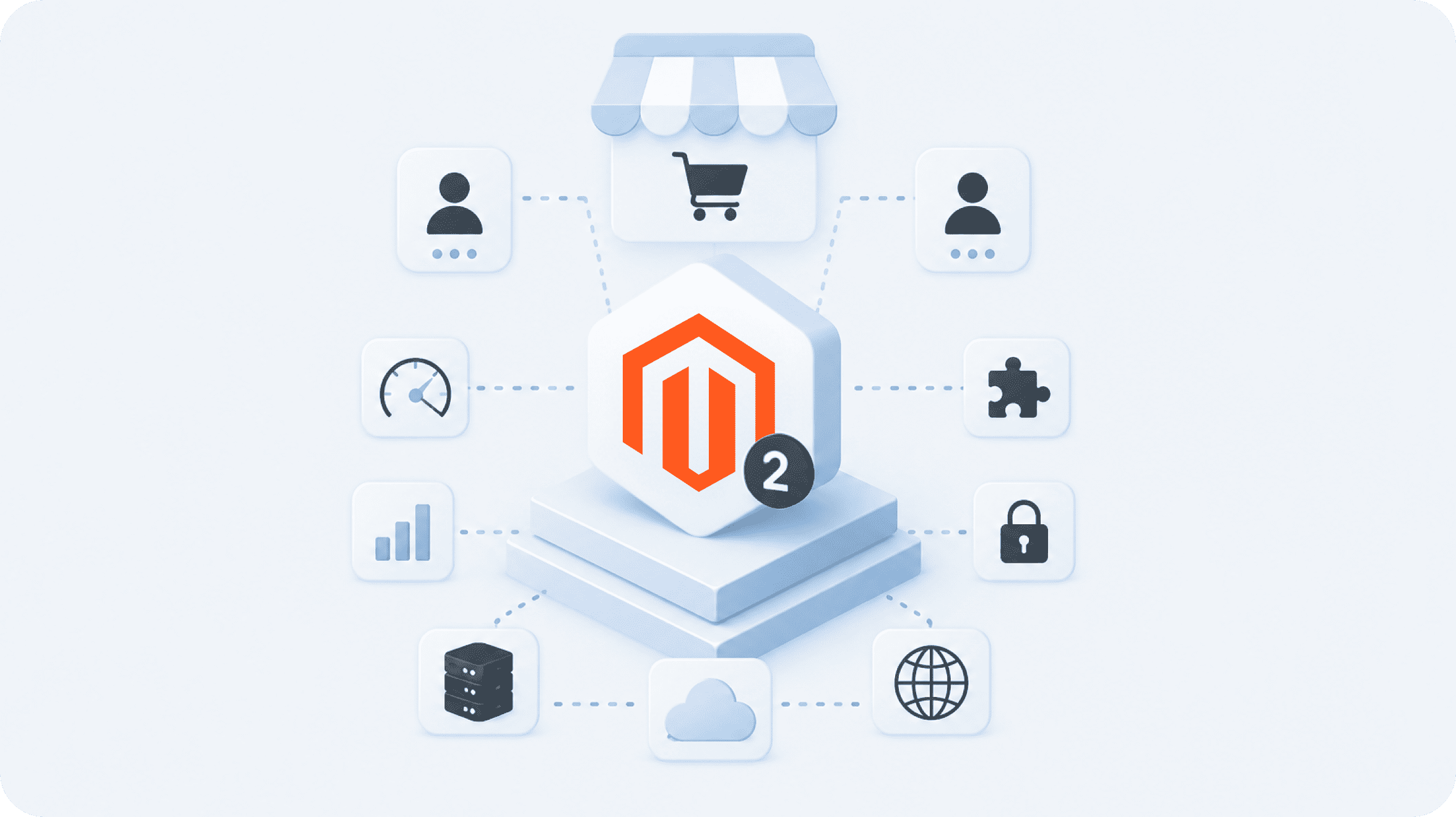
Magento 2 remains the foundation for complex eCommerce solutions for good reason. Its strength lies in how it handles scale and complexity. Hundreds of large commercial projects across different industries are built on its architecture - from classic retail marketplaces and fashion platforms to B2B distribution, electronics, and niche eCommerce ecosystems with high load and complex order logic.
This isn't a matter of the technology's popularity, but of the fact that it can handle diverse business models, complex pricing rules, ERP/CRM integrations and continuous catalog growth without losing manageability.
1. Scalability
Magento handles large catalogs with ease - hundreds of thousands of SKUs, complex attributes, filters, configurable products. For a marketplace, that's a baseline requirement.
It also distributes load across system layers - catalog, indexing, caching and business process logic. This lets you scale not just data volume, but the number of operations, without a critical drop in performance.
2. Architectural flexibility
Any business logic - commissions, roles, pricing rules - can be implemented without technical workarounds. With Magento 2, a business can add new features without rewriting the core.
3. B2C + B2B capabilities
Out of the box, it supports scenarios for different types of sales:
corporate accounts
custom pricing
complex order rules
peak sales periods
expansion into new markets (cities, countries)
For marketplaces with heavy mobile traffic, PWA architecture on Magento 2also plays a separate role, speeding up the frontend and improving UX for mobile users.
4. Transaction security
With a high volume of payments, controlling financial flows is critical. Magento provides the necessary level of control, architectural foundation and integration options: from connecting payment systems with split payments to building custom financial logic that lets you control commissions, vendor payouts and the status of every transaction in the system.
For marketplaces handling large volumes of payments and user data, it's also critical to run regular Magento security audits.
These are the reasons Magento is often chosen not at the MVP stage, but once a business already understands its model will scale and can't afford technical constraints.
It lets you build an architecture that grows along with the business.
But Magento 2 on its own is just the foundation. The core value of a marketplace is created at the functionality level. And at that point, what matters isn't just what you're building on, but how the platform will actually work behind your specific scenarios. Because the real difference between platforms shows up not in the technology, but in the functionality behind the processes.
Core marketplace functionality on Magento: where success actually hides
Vendor Dashboard: an isolated system for every seller
One of the most common planning mistakes is underestimating the role of the seller account. On a marketplace, this isn't just an extra section - it's a separate system within the platform.
What this means in practice
Each seller gets their own isolated space where they can:
add and edit products independently
manage prices and stock
process their own orders
view their own sales analytics
communicate with buyers
At the same time, they:
have no access to the Magento admin panel
can't see other sellers
can't affect the system as a whole
This is critically important. A marketplace isn't just about sales - it's also about control.
A properly implemented Vendor Dashboard:
reduces the load on the platform owner
lets you scale the number of sellers without growing the team
minimizes the risk of errors and interference
This is exactly where you can tell whether a platform is ready to grow.
Split payments and commissions: how a marketplace's financial logic works
The hardest part of a marketplace isn't the catalog - it's the money.
Picture a typical scenario: a customer places a single order that includes products from three different sellers. The main question is: how do you correctly split the payment?
If this isn't planned for, chaos follows:
manual payouts
complicated accounting
errors and disputes with sellers
Modern marketplaces solve this with split payments.
How it works:
the customer pays for the order in a single payment
the system automatically splits it
funds go directly to the sellers
the platform immediately receives its commission
Integrations (such as Stripe Connect or local payment solutions) make this transparent and automatic.
Marketplaces are also increasingly integrating Apple Pay and Google Pay to simplify checkout and improve conversion.
On top of that, you can:
set different commission rates for different categories
implement separate delivery logic for each seller
split orders into multiple shipments
The end result is that the owner gets not just a store, but a managed financial system.
Once the basic marketplace logic is clear, the next practical question comes up: how do you implement it quickly and without unnecessary cost - build everything from scratch, or use ready-made solutions?
Ready-made modules vs. custom marketplace development: where's the line
The market already offers solutions that can speed up a marketplace launch. One of the strongest is the VNECOMS Marketplace Extension. It's a powerful module that covers the basic functionality:
Vendor Dashboard
product management
a basic commission system
seller roles
It can serve as a foundation for a fast start. But there's a key thing to understand: no module accounts for your specific business model.
Every marketplace has its own nuances:
rules for onboarding sellers
commission logic
order processing scenarios
integrations with ERP, CRM, delivery
In practice, any module needs to be:
configured
adapted
customized further
And that's where the real development work begins.
For tasks like these, it matters less to simply install a module and more to design the architecture correctly. That's why we treat building a marketplace on Magento 2 as a distinct development track, not as a standard extension install.
A module gets you 60-70% of the functionality.
The remaining 30% is what determines your competitive advantage.
On Planeta Web projects, we regularly see the same pattern: a business comes to us asking to "install a marketplace module," but what's actually needed is rebuilding the process logic around real sales, financial and seller-interaction scenarios. And that part is what determines whether the platform will scale or stay a marketplace demo.
A module is a starting point, not the solution. All the hard parts start after it's installed: commissions, roles, integrations, order processing. And if this isn't thought through at the start, you end up having to rebuild a business that's already running.
Magento Developer, Planeta Web
That's why our job isn't just to integrate the module, but to adapt it to the business model:
rebuild the commission logic around the client's financial model
set up roles and access levels to match how the business actually operates
integrate payment systems, delivery and accounting
ensure scalability without technical debt
As a result, the module becomes part of a managed system.
But even perfectly implemented functionality isn't the ceiling for a marketplace. Today, competitive advantage is increasingly built at the data level - and in how the system works with that data.
Trend watch: how AI is changing marketplaces right now
A few years ago, AI was an interesting experiment. Today, it's an optimization tool.
But here's the important part: in Magento's case, AI isn't a standalone product- it's a layer that integrates into the existing architecture and works on top of the catalog, search and user behavior.
In this setup, Magento acts as the foundation platform: it stores the catalog, users and orders, while AI services process that data and feed results back into the frontend as search, recommendations or content.
By AI in this context, we mean not a single technology but a set of generative models along with search and recommendation systems, for example:
LLMs / generative AI (such as OpenAI GPT) - for product descriptions, SEO copy, content normalization
AI search and search platforms (Algolia, Doofinder, ElasticSuite, Multisearch, Searchanise) - for smart search
Recommendation engines / ML models - for personalized recommendations (sometimes SaaS, sometimes custom-built)
NLP (natural language processing) - to understand user queries, synonyms, intent and behavior
The question isn't really whether to use AI, but where exactly it strengthens your marketplace and how to integrate it properly into the Magento ecosystem.
Right now, AI is used in Magento marketplaces in three key areas:
1. Smart search
The system understands:
typos in queries
synonyms
user intent
This reduces empty search results and directly affects sales.
In Magento, this is implemented through integrations with search services - at a basic level, Elasticsearch or OpenSearch, which handle indexing and delivering results.
But search only becomes smart once solutions like Algolia or custom AI integrations are connected. They're what adds typo tolerance, autocomplete and intent-based logic.
Technically, this is a combination of search platforms and NLP (natural language processing) models that interpret user queries and make search contextual rather than literal.
In effect, search stops being just a catalog filter and becomes a sales tool.
2. Personalized recommendations
Algorithms generate blocks like:
"frequently bought together"
"you might also like"
This increases average order value and browsing depth.
Magento lets you connect recommendation engines as separate services or build your own logic based on user data.
In effect, the system just provides the data - browsing history, purchases, catalog behavior - while AI builds recommendations on top of that layer.
This is where ML (machine learning) models come in, analyzing user behavior and shaping personalized interaction scenarios with the catalog - either through ready-made SaaS solutions or a custom build tailored to the business logic.
This is what makes the marketplace start working for the user, instead of just displaying a catalog of products.
3. Content generation
AI helps:
create SEO descriptions
scale content across thousands of products
maintain catalog quality without manual work
For a marketplace with many sellers, this is critical.
In Magento, this matters especially because of the marketplace model: content is created by vendors, and its quality is almost always uneven.
Here, AI acts as an outer layer: it generates, improves or standardizes content, while Magento structures and displays it in the catalog.
This is where LLMs (large language models) come in, letting you automatically create or optimize copy - from basic product descriptions to SEO content - while keeping a consistent style and quality.
This makes it possible to normalize product descriptions, automatically improve SEO and maintain a consistent quality level across the catalog.
Ultimately, Magento's strength is that it lets you integrate any AI to fit your logic. And this isn't just a trendy feature anymore - it's a way to scale efficiency without a proportional increase in team size. As the number of products and sellers grows, the system needs to get smarter, not more complex and expensive to manage.
And that's the key difference: with SaaS solutions you're limited to what's already built, while with Magento you can build a solution around your specific marketplace model.
Once you understand the functionality and possibilities, the main business question naturally follows - what does this translate to in budget terms, and how is the launch cost formed?
How much does it cost to launch a marketplace on Magento 2
To get a realistic budget estimate, it's best to start by analyzing the business model, the number of sellers, commission logic and integrations. On our Magento 2 marketplace development page, we describe how we approach these projects.
One of the first questions businesses ask is: what does marketplace development cost? It's worth stating upfront: there's no universal figure or price list. But we can break down the logic behind the budget.
The cost of building a marketplace on Magento 2 is made up of:
license and module costs
development (team hours)
functionality customization
payment system integration
delivery setup
performance optimization
Keep in mind that a marketplace almost never exists in isolation - it functions as part of the business's broader ecosystem. And its connection to ERP, CRM, warehouse and accounting systems, and analytics, accounts for a significant share of the project's complexity and cost.
All of this determines how manageable the marketplace will be in real life, not just within eCommerce logic.
The answer to how much marketplace development costs also always depends on: the number of sellers at launch, the complexity of the commission logic, integrations, and UX and speed requirements.
In reality, you're not paying for a website - you're paying for a digital platform. And the budget here is an investment in the business model.
Keep in mind that budgeting for a marketplace is only part of the picture. It's also worth preparing for and understanding the risks - things that aren't visible at the start but can significantly affect the outcome after launch.
Pitfalls that become problems after a marketplace launch
Performance and caching
Without proper optimization, a marketplace quickly starts to slow down under load.
A key element here is the Varnish cache.
Varnish is an HTTP accelerator (reverse proxy) that caches finished pages at the server level and serves them to users without hitting Magento again. Instead of rebuilding a page from scratch every time (from the database, modules, business logic), the system serves an already prepared result.
It allows you to:
reduce server load
speed up page delivery
stabilize performance under heavy traffic
For a marketplace, this is critical, because load is generated not just by traffic but also by the number of sellers, products and parallel requests to the system. Without caching, every page view is a full computational process.
It's important to understand that Varnish isn't the only tool - it's part of a broader performance architecture.
It's complemented by:
CDNsolutions (such as Cloudflare) that cache content closer to the user
Magento's built-in cache
database query optimization
indexing and catalog handling
Alternatively, some projects use Full Page Cache without Varnish, or a web-server-level solution (Nginx FastCGI cache), but in most high-load scenarios Varnish delivers the most predictable results.
Without this, even a strong platform can run slowly - and the problem isn't Magento itself, but an architecture that isn't ready for the load.
That's exactly why Magento 2 optimization becomes a distinct stage of marketplace development after launch.
SEO cannibalization
A common marketplace problem is duplicate products, since the same product can be sold by multiple vendors.
Without controlling this:
duplicate pages appear
SEO performance drops
your own pages end up competing with each other
The solution involves accounting for:
canonical URLs
merging product listings
a properly structured catalog
We plan for this at the architecture stage.
We're happy to discuss cases and risks specific to your particular products or services.
Ultimately, all of this comes down to one thing - a marketplace needs to be treated not as a website, but as a system that has to run reliably as it grows.
After launch, these projects also need ongoing Magento 2 technical support - from updates and monitoring to performance stabilization and keeping integrations running.
This isn't about choosing a tech stack - it's about building a managed model: with control over sellers, transparent financial logic and the ability to scale without chaos. Magento 2 provides the foundation, but the outcome always depends on how that architecture is implemented for a specific business.
So it's worth starting not with design, and not with the platform, but with the model:
how you make money
how you onboard sellers
how you structure commissions
how you plan to scale
These are the decisions that determine whether the marketplace becomes a working business tool or stays a technical build with no economics behind it.
At Planeta Web, we work through these scenarios together with clients - and only then shape the technical solution around the goal.
Planning to launch a marketplace or migrate an existing platform to Magento 2? Check out our marketplace development service or leave a request - we'll help you evaluate the idea, the risks and the launch budget.
Because a strong marketplace doesn't start with code - it starts with the right logic.
Frequently asked questions about launching a marketplace on Magento 2
Is Magento 2 a good fit for a marketplace?
Yes, Magento 2 is well suited for complex eCommerce platforms with multiple sellers, large catalogs, B2B logic, ERP/CRM integrations, payment systems and delivery.
Can you launch a marketplace using a ready-made module?
Yes, a ready-made module can speed up the launch, but it almost always needs to be adapted to the business model: commissions, seller roles, financial logic, delivery, integrations and order processing.
How much does marketplace development on Magento 2 cost?
The cost depends on the number of sellers, catalog complexity, commission logic, integrations, design, performance requirements and the level of customization.
What integrations does a marketplace need?
A marketplace typically needs integrations with ERP, CRM, payment systems, delivery services, analytics, search, warehouse systems and tools for communicating with sellers.
Where should you start when launching a marketplace?
Start not with design, but with the business model: how the platform makes money, how it onboards sellers, and how commissions, payments, delivery, the catalog and scaling work.