
About 62% of shoppers postpone or cancel a purchase if a store doesn't support their preferred payment method (E-Commerce Trends Report 2026, DHL). But have you ever analyzed what exactly your customers are missing to complete their purchase? Let's talk — we're confident you'll walk away with at least a few tips right away. Or we can simply continue our series of publications on e-commerce development. We have already covered delivery modules and integrations. Next up is one more service that makes it hard to sell more without it.
Installment Payments for Online Stores: Which Banks to Connect in 2026
Imagine two shoppers dreaming of a new sofa.
The first one sees a product in your store for UAH 24,000. Even though his wife insists on buying it, he puts it off, because he decides: unfortunately, now is not the time for such expenses. The second man sees the same UAH 24,000 sofa, but next to the price there is an attractive option: pay just UAH 2,000 per month. For him, the purchase looks completely different. And if the delivery logistics on your site are well organized, most likely the day after tomorrow his family will be watching a movie on the new sofa
The product didn't get cheaper, and the customer didn't get any more money. The only thing that changed is the threshold they have to cross to click "Buy".
That is why installment payments have become important for e-commerce. For a store, this is not just one more payment method at checkout. It is a tool that makes a more expensive product psychologically more affordable, lowers the barrier to purchase and gives the customer more freedom of choice. And for you — more loyal customers.
Moreover, in 2026 Ukrainian shoppers are already used to seeing this option in large online stores. If it's simply not there, they will go to a store where it is. The good news is that you're now in the right place — we create such opportunities every day.
Take care of your customers' comfort and the growth of your average order value — we're here to help. Below, we explain which banks are worth adding and what to keep in mind.
What Are Installment Payments for an Online Store?
The mechanics are simple: instead of paying the full price of a product at once, the customer takes out a bank credit product and repays the amount in equal payments over a set period.
For example, a product costs UAH 30,000. Instead of a single payment of UAH 30,000, the customer can choose 6 payments of roughly UAH 5,000 each — depending on the specific bank, the store's terms, the specifics of the credit product and your pricing logic.
For the customer, it is a way to spread out expenses. For the store, it is a chance not to lose a sale just because paying the full amount today is inconvenient for the customer.
However, there is an important nuance: installment payments from different banks are not the same product. Each bank always differs in terms, customer conditions, application method, card or credit limit requirements, seller fees and technical integration model. This is especially true for different platforms that stores are built on, as well as their mobile versions.
Because of these differences, the question is not whether to add this feature. The benefit is obvious, and the data on a 15–20% increase in purchase frequency is confirmed.
The question is which banks your customers actually need. The key is to first understand your own payment statistics.
How Installment Payments Work on a Website
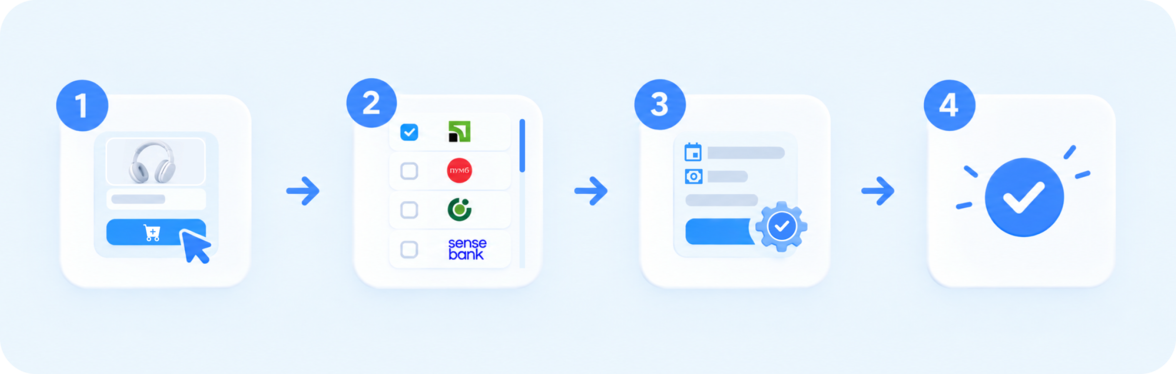
For your store's visitor, the flow is almost identical to regular payment.
They add a product to the cart, proceed to checkout and see the available payment methods — for example, card, Apple Pay, Google Pay and installment payments through one or several banks. After choosing a bank, the customer goes through the standard confirmation in the bank's app or on the bank's page. The bank checks the available credit limit and approves the transaction. If everything is fine, the store receives confirmation of successful payment and can process the order as usual.
In other words, just a few simple extra steps and a bank logo on the product page.
For the seller, behind this service stands a full integration of the payment service with the store's platform, correct transfer of order data, and correct handling of statuses, refunds and errors.
Which Banks tao Connect to Your Online Store in 2026
Several services operate in Ukraine through which a store can offer customers installment payments. And in reality, there is no universal set that fits everyone. The choice of banks depends on the store's audience, average order value, product categories, the bank's terms and the cost of connection for the business. Let's start with the most popular ones.
PrivatBank — "Pay in Parts"
PrivatBank has one of the best-known services on the Ukrainian market — "Pay in Parts" ("Оплата частями"). The customer chooses a partner store, a product and the number of payments, then confirms the purchase through Privat24.
The bank states that the service already works in more than 5,000 online stores.(privatbank.ua )
For businesses, it matters that the number of payments affects the service fee. PrivatBank's current tariffs for online stores include options from 2 to 25 payments.(privatbank.ua )
There is also an interesting e-commerce change in 2026: customers can extend the "Pay in Parts" term on their own — within the service rules and up to a set maximum. For example, if a store offers 5 payments, the customer can extend the term to 10 by paying an additional fee.(privatbank.ua )
Best for: stores with a large PrivatBank audience, sellers of appliances, electronics, furniture, home goods, premium clothing and other categories with a medium or high average order value.
monobank — "Buy in Parts"
monobank offers the "Buy in Parts" service.
For the customer, it is a way to split the cost of a purchase into several payments with no overpayment on their side — the service fee is paid by the seller. monobank currently advertises up to 24 payments on its customer page, while the API for stores supports a flexible range of 3 to 25 payments.( monobank)
Interestingly, the bank emphasizes not only the installment itself but also the speed of application: a credit decision can be made in about 20 seconds.
For an online store this matters for one reason: the less your checkout makes the customer wait, the lower the chance they change their mind at the last step.
The integration works via API, so a store can embed "Buy in Parts" directly into its own checkout flow. ( monobank )
Best for: stores with a young, digital-savvy audience, electronics, appliances, fashion, home goods, beauty and other categories where customers actively use monobank.
PUMB — "Pay in Parts" ("Pay in Parts")
PUMB is developing its own service, "Сплачуйте частинами" ("Pay in Parts").
Current terms allow purchases for a period of 2 to 24 months. For the term set by the store, the customer pays no overpayment; if they wish, they can extend the term for an additional fee. The first payment is not charged on the day of purchase — it must be made within the following month.(ПУМБ)
The connection scenario is also interesting for stores: PUMB openly invites businesses to become service partners and lets them send the customer a request, which the customer confirms in the app.(ПУМБ для бізнесу)
Separately, PUMB has a service called "Частями WORLD" ("Parts WORLD"), which lets customers get an installment plan even for purchases on sites that have no installment payment option of their own. This is a different model and does not replace a store's partner integration, but it shows how actively the very logic of e-commerce installments is changing.(About PUMB)
Best for: stores with a medium or high average order value, appliances, electronics, furniture, home goods, clothing and other categories where not having to pay the full amount on the day of purchase can influence the customer's decision.
A-Bank
A-Bank is also worth considering among the banks to connect for installment payments.
Having it at checkout can matter not because the customer is specifically looking for an "A-Bank installment plan," but because they already have a credit limit with this bank.
This is one of the main reasons why, for a large store, connecting several banks may make more sense than betting on a single service: the customer comes with their own bank, their own limit and their own familiar way of paying.
Terms and the available number of payments depend on the current partner program and should be verified during connection.
OTP Bank — OT Pay in Parts
OTP Bank is developing an installment solution through "OT Pay in Parts" ("OT Pay частями").
For an online store, this is one more way to give customers a choice of bank at checkout instead of limiting them to a single credit product.
It makes particular sense for stores with expensive products, where the customer may compare not only the price of the item but also the available financing term.
Exact terms, tariffs and the integration format depend on the current conditions of OTP Bank's partner program, so they should be agreed with the bank before launch.
Sense Bank — "Easy Installment"
Sense Bank offers the "Easy Installment" ("Легка розстрочка") service for credit card holders.There is an important technical point for stores: Sense Bank supports API integration of this product. For the customer, the bank states that an installment plan can be arranged for a period of 3 to 24 months. ( Sense Bank)
In other words, this is not a scenario where the customer later converts the transaction into an installment plan on their own. The store can integrate the corresponding payment method directly into its e-commerce flow.
This is especially important for stores whose checkout is already optimized and whose owner doesn't want to send the customer through a workaround.
UKRSIBBANK — "Payments in Parts"
UKRSIBBANK has a "Payments in Parts" ("Виплати частинами") service for holders of the bank's credit cards.
Current terms provide for a period of 3 to 24 months, and the credit amount can range from UAH 300 to UAH 300,000, depending on the available credit limit. Applications are available both online and in physical partner stores.;( UKRSIBBANK )
An important point for the customer: they confirm the purchase terms through UKRSIB online.
For the store, it is a chance to add one more bank at checkout that customers already know.
Globus Bank — GlobusPlus
Globus Bank is developing credit products in its GlobusPlus app. In 2026, the bank, among other things, updated the contract terms of its "Installment Expenses" ("Витрати в розстрочку") program, available in the GlobusPlus mobile app.(Глобус Банк )
For an online store, connecting this payment method can be an additional sales channel among the bank's customers.
At the same time, the specific terms and commercial conditions for the store are best clarified at the connection stage, as they may depend on the current partner program.
Alliance Bank — "Pay in Parts"
Alliance Bank has its own service, "Pay in Parts by Alliance" ("Оплата частинами від Alliance").
A purchase can be split over a period of 3 to 24 months, and the first payment is made one month after purchase. The bank also lets customers increase the number of payments in the app; when the term is extended, an additional monthly fee applies.(Alliance Bank)
For businesses, this is one more argument in favor of a multi-bank checkout: the customer doesn't have to switch banks or look for another way to finance the purchase.
Why It's Better to Connect Several Banks at Once
At first glance, it seems enough to connect one popular service — for example, PrivatBank or monobank — and you already have an edge over competitors in your segment who don't offer this.
But imagine the checkout from the customer's side.
They already have a credit limit with their own bank. They are used to its app. They know how purchases are confirmed. And when they see a familiar logo on the site, they don't need to figure out what to do next.
If that bank isn't there, an extra barrier appears.
So several banks are not just more payment methods. They are a higher chance that a specific customer will find a scenario they're used to.
This is especially noticeable in stores with expensive products.
When the order total is UAH 30,000, 50,000 or 100,000, the difference between "I can pay now" and "I can split this amount over several months" becomes much more tangible.
It is also important to look not only at the number of banks but at the visibility of installment payments — particularly on the mobile version of the site.
If the customer learns about the installment option only at the last step of checkout, you have already lost part of its potential.
For expensive products, it makes sense to show the installment option already on the product page:
UAH 24,000 or from UAH 2,000/month.
Then installments work not only as a payment method. They become part of the product presentation.
You might ask: what guarantee is there that customers will buy from me? It's a fair question — after all, a person can take a loan from a bank directly and pay the store the full amount. That is why at Planeta Web we start any service with a comprehensive analysis. Attractiveness is influenced by understanding customer behavior, speed, design, SEO, site logic and many other factors. Even connecting installment payments with us gives you the advantage of a full-cycle team's experience, one that handles projects of all scales.
Installment Payments Can Increase More Than the Number of Purchases
There is one more effect that is often forgotten. When a customer evaluates a product through a monthly payment, the very frame of choice changes.
For example:
UAH 10,000 nowand ≈ UAH 830 per month are perceived psychologically in completely different ways.
This doesn't mean every customer will automatically spend more. But the store gets an opportunity to present a more expensive product through a different financial model.
That is why installment payments should be tested not only on checkout conversion but also on:
average order value;
product page conversion;
share of expensive products in orders;
number of abandoned checkouts;
conversion of customers who see the installment option;
share of orders through each bank.
Only then can you understand the real business value installments bring to your particular store.
What a Store Should Consider Before Connecting
Choosing banks is only half the task. Before connecting, you should take into account at least four aspects.
Fees
Installments are not free for the store. For example, at PrivatBank the fee depends on the number of payments: the longer the term, the higher the cost of the service for the seller. (privatbank.ua) So you need to calculate not only how many customers this will bring, but also the economics of the order itself.
Range of payments
Not every product needs 24 months. For clothing, a few payments may be enough. For furniture, appliances or professional equipment, a longer term may be significantly more appropriate.
Return scenario
What happens if the customer returns the product? This scenario must be implemented correctly both on the store's side and in the bank integration.
Technical integration and mobile-first
The payment method must be displayed on the site in every version of it. It must also correctly handle:
payment creation;
confirmation;
successful payment;
decline;
cancellation;
refund;
order status changes.
This is especially important for Magento and other complex e-commerce systems, where payment is directly tied to order logic, stock reservation, delivery and accounting.
In fact, how complex and expensive it is to implement all these statuses depends directly on the platform your online store is built on. For a business owner, the difference lies not in technical code but in cost, complexity and speed of launch.
How Your Site's Platform Affects the Launch of Installment Payments
If your store is built on WooCommerce (WordPress), you're lucky with flexibility: there are many ready-made free plugins from Ukrainian banks for this platform. However, there is a catch — because of the large number of third-party modules, they must be carefully tested. A ready-made plugin may conflict with your theme or other extensions, so checking that the checkout works correctly is a mandatory step.
With Shopify, the situation is different: you get stability, but you become dependent on the platform's rigid limitations. Connecting Ukrainian banks "in one click" directly is not always possible because of Shopify's internal policy on payment gateways. You'll have to use the integrations that are already officially available and permitted by the platform, which sometimes limits your freedom of choice.
For large-scale projects on Magento (Adobe Commerce), launching installments is almost never simple out of the box. If you want to offer customers a choice and connect several different banks at once, a standard module won't be enough. You'll need developers for serious customization or for building a separate custom integration, which will increase the budget and the time to launch.
Custom-built sites give you the most freedom, but also the highest costs. There are no ready-made solutions here, so the integration is built from scratch via the bank's direct API. This means developers have to code every action manually. It is the longest and most expensive path, but it lets you tailor the design and payment logic perfectly to your business processes.
How to Connect Installments to Your Website
Connecting installment payments usually consists of several stages. First, we determine which banks the store actually needs. It isn't necessary to integrate all available services at once.
Next, we agree on terms with the banks or a payment partner and choose the integration method.
After that, a developer connects the API or a ready-made payment module and sets up the transfer of order data and the handling of bank responses. But the work doesn't end there.
You need to test the real checkout: successful payment, decline, cancellation, refund, different amounts and numbers of payments. Only after that should installment payments go live on the production site.
So that the user can: choose a product → see the available monthly payment → choose a bank → confirm the purchase. And all the complexity should stay on the integration side, not on the customer's.
Does Your Store Need Installment Payments?
If the store's average order value is low, customers mostly pay for orders immediately, and the margin doesn't allow for the bank's fee, connecting installments won't necessarily be a priority.
But if you sell appliances, furniture, electronics, professional cosmetics, sports equipment, designer clothing, home goods or any other products with a noticeable price tag, the question deserves a separate calculation.
Look at your analytics. How many customers reach checkout but don't pay for the order? How many people add an expensive product to the cart but put off the purchase? What is your average order value? And most importantly — how many customers could buy the product right now if they didn't have to pay the full amount in a single payment? The answers to these questions are far more useful than simply comparing a list of banks. And we will help you work them out.
How Planeta Web Connects Installment Payments
At Planeta Web, we look at the store itself first, not at the module: we analyze the platform, the payment system, the average order value, the current payment methods and the checkout flow.
Then we determine which banks and payment services make sense for your particular audience.
We can connect a single service or build a multi-bank checkout in which the customer sees several installment options.
For Magento and Adobe Commerce, we work directly on the payment logic integration: from connecting the API or module to testing real payment, cancellation and refund scenarios.
And then you can go one step further — look at where exactly to show installments on the site, so that they work not only at checkout but also help sell expensive products before the order is even placed.
Because a good integration is when it becomes easier for the customer to tell themselves: "Yes, I can afford this, and I want it."
If you need to connect installment payments for your online store, sort out the banks and integrate them into your site without unnecessary experiments — contact Planeta Web. We'll review your platform, payment system and audience, and choose a connection scheme that makes sense for your e-commerce.