
What Drupal is and why it matters for business
Drupal can be thought of as both a content management system and an architectural framework platform. Compared to simpler website builders, businesses choose Drupal when the site stops being a storefront and becomes part of the business infrastructure: it affects operations, sales, marketing, analytics, and interactions with customers and internal teams. In these projects, the digital product is just one layer of the system, not its boundary.
Drupal fits businesses where the logic is more complex than page design, where access control, security, stability and the ability to change the rules of the game without a full product relaunch matter.
Why Drupal stays relevant in a changing digital landscape
The CMS market changes fast: new builders appear every year promising a quick start and minimal cost. Drupal has been around for more than twenty years and is used where the cost of a mistake is high and architectural requirements are critical.
The secret to its staying power isn't mass adoption, it's predictability. Drupal was never simplified to chase popularity. It evolved alongside business needs, toward security, scalability and architectural flexibility. Fewer Drupal sites over time has become a different kind of metric altogether, one of quality and the level of responsibility behind the projects that choose it.
That's why it's chosen for long-term solutions that need to run for years and adapt to change without losing stability.
Is Drupal a CMS or a CMF platform?
Drupal is often called a CMS, but by nature it's a Content Management Framework.
The difference is fundamental:
A CMS offers ready-made scenarios and a limited data model.
A CMF lets you design your own.
Drupal lets you:
build complex data structures
manage user roles and access permissions
combine content, services and integrations into a single system
implement logic that no plugin can replicate
That's why Drupal is used where the site is just the interface to a more complex system. It's a platform that adapts to the business model. Drupal scales well, doesn't constrain the architecture, and stays relevant over the long life cycles of digital products.
Where Drupal works best: business scenarios
Drupal is used where the digital product is a system, not a set of pages. For example:
In enterprise platforms with a multi-level content structure and complex access rights for different teams and partners.
In media — where handling large volumes of content, editorial roles, workflows and integrations with analytics and ad services matters.
In services with customer accounts — Drupal becomes the logic core: it manages users, roles, data and interaction scenarios.
In educational, cultural and government projects the platform is valued for security, stability and control — qualities that are hard to deliver with simple website builders.

What Drupal integrates with: the platform's key strength
Drupal is often chosen for its ability to serve as an integration hub. It performs well in environments where the site is a node in a larger system.
1.
Drupal integration with CRM and sales systems
Drupal integrates easily with CRM because it was designed from the start as a system with a clear data and role model.
Typical scenarios:
form submissions, leads, and registrations from the site go straight into the CRM;
users see deal, contract and inquiry statuses in their account;
content and marketing pages pull data from the CRM (for example, personalized offers).
Here, Drupal isn't just a collection form, it's the controller of the logic: what to pass, to whom, when and in what context.
2.
Drupal integration with ERP, accounting and internal systems
In more complex businesses, Drupal is often integrated with ERP or custom internal systems.
In practice, this looks like:
the site or portal displays up-to-date data from accounting systems;
access to information depends on the user's role;
some operations are triggered from the web interface but executed in internal services.
Drupal makes it possible to clearly separate the responsibilities of each system instead of forcing everything onto a single platform.
3.
Drupal integration with payment systems and finance
Drupal is often used in projects where payment is just one part of the scenario.
Examples:
subscriptions, installment payments, complex access rules;
different payment providers for different countries;
integrations with billing systems.
This way, we build payment directly into the business logic.
4.
Marketing and analytics tools integrated with Drupal
Drupal works well alongside analytics and marketing, especially when what matters isn't just statistics but the context of user behavior.
Typical integrations:
web analytics systems;
CDP, email marketing, campaign automation;
content personalization based on behavior and roles.
Here, Drupal's value lies in knowing its users — what they can do and what they've already done — rather than just tracking clicks.
5.
Media, DAM and external content services integrated with Drupal
Drupal deliberately doesn't try to store all content in one place, a result of the platform's architectural maturity. Specialized content types are stored wherever it's most efficient, while Drupal handles structure, usage rules and access control.
In practice, this is implemented through integration with:
DAM systems for handling large volumes of media files, and external video and streaming services, without losing control over content.
In this model, Drupal acts as a content orchestrator rather than an overloaded CMS repository. Centralized content management from a single core for multiple sites or applications makes the system faster, more stable and easier to scale.
6.
Frontend frameworks and mobile apps
In decoupled / headless architectures, Drupal often integrates with:
modern frontend frameworks;
mobile apps;
third-party services that consume the API.
In this case, Drupal is an API-first platform that manages data, access and logic, not the presentation layer.
7.
Custom services and microservices
For complex ecosystems, Drupal works well as part of a microservices architecture. This means some logic is offloaded to separate services, Drupal coordinates the processes and data, and the system can evolve gradually without a major rewrite.
Why integrations are a strength of Drupal
they don't break the core;
they don't turn the system into a pile of plugins;
they don't limit the business down the road.
Drupal is well suited to cases where the site is an entry point into business processes rather than an isolated product.
Drupal architecture and open source: an expert view of the technology
Drupal is distributed as open source, but its business value isn't in being free, it's in architectural transparency and control. Open source means the system's logic isn't hidden inside the platform: the business has full control over data, processes and the product's development path, without critical dependence on a single vendor or closed ecosystem.
From an architectural standpoint, Drupal is built as a modular system:
the core handles stability and security,
while business logic is defined at the level of configuration, custom modules and integrations.
This lets us design complex data models, multi-level access roles and nonstandard interaction scenarios without compromising scalability or maintainability.
In practice, Drupal works well as an integration hub: it connects content, users and business processes with CRM, ERP, analytics, marketing and internal systems. The platform doesn't impose a rigid structure, it lets you build a digital product around the company's actual processes instead of forcing the business to fit the CMS's limitations.
In modern projects, Drupal is often used in a decoupled or headless architecture, where the backend and frontend evolve independently.
In this model, Drupal handles data, access rights, business logic and integrations, while client interfaces can be built on any technology, from classic web frameworks to mobile apps.
This approach delivers strategic advantages for the business:
strong performance, speed and Core Web Vitals
freedom to design complex UX,
the ability to scale the system without rewriting the core
and use a single backend foundation for multiple services, products or channels.
As a result, the Drupal platform becomes the controlling backend hub for data and logic across the entire digital ecosystem.
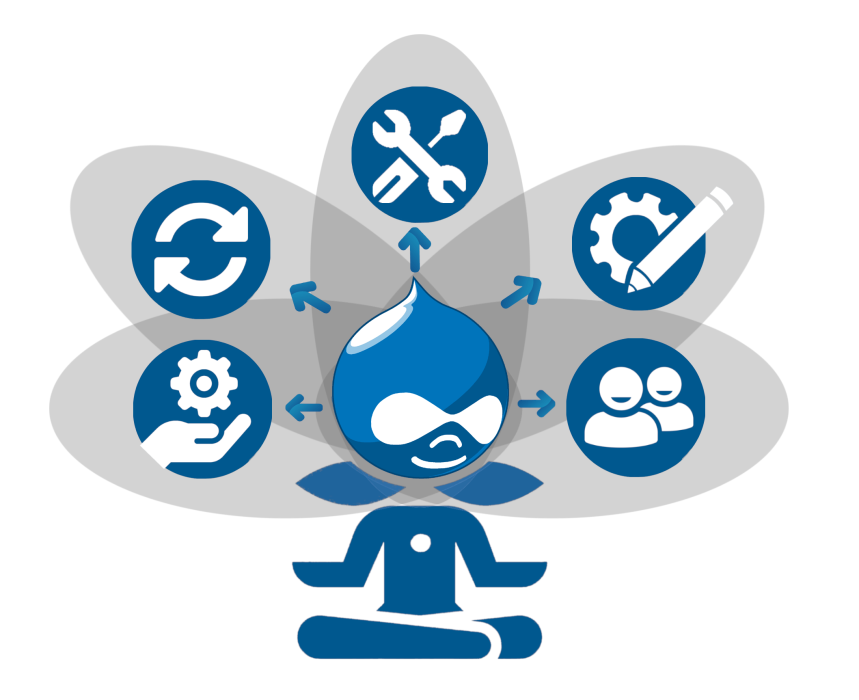
Senior team: Planeta Web's approach to Drupal
For us, Drupal isn't a default platform, it's an engineering tool that has to match the real complexity of the business. It's used when the logic demands more flexibility than a classic CMS or eCommerce platform can offer, and requires a flexible architecture, control and long-term development. We start by analyzing processes and goals, design the system before development begins, and staff the project with a middle+ and senior-level team.
How we deliver Drupal projects: key stages
We run Drupal projects iteratively to ensure predictability and control.
Research and planning
We study the business, the niche, the goals and the constraints. We build an architectural vision and a prototype that answers the key question: how to make the product stronger than the competition before development even starts.
Design and UX
We design a best-in-class customer experience that supports the product's logic, adapts to every device, and serves business goals, not just the visual layer.
Development and integrations
We build the system with security, speed and scalability in mind. We integrate external services, analytics and marketing tools.
Testing and launch
We check functionality, integrations, SEO readiness and stability across devices.
The project launch marks the start of managed growth.
Drupal in Planeta Web's technology ecosystem
We work with different platforms, choosing the technology to fit the task. Magento for eCommerce. Drupal for complex platforms and systems. This approach lets us be a technology partner to the business, not just a vendor for individual tasks.
Our team includes technical architects, Drupal developers, frontend engineers, UI/UX designers, marketers and SEO specialists.
We help you move:
from idea
to product
to growing KPIs
to scaling into new markets