
This article will be useful if you recognize yourself in at least one of these scenarios:
Your server costs are growing as fast as your revenue — along with the sense that they're eating into your scaling
You're planning to launch or grow a Magento 2 store and want to build the right infrastructure from the start
You want to understand how CDN and edge architecture affect eCommerce performance and costs, and how they differ from Magento's classic cache (Varnish)
Why eCommerce infrastructure gets more expensive faster than revenue grows
Delivering more while paying less sounds like a great plan. But in reality, many eCommerce businesses see the opposite happen.
More traffic means more servers.
More promotions mean more load.
More international sales mean a more complex infrastructure.
In the classic scaling model, this often looks like:
+20% traffic
+20–30% server load
+30% cloud bill
But the problem is that business margins don't always grow by the same 30%. The result is a familiar feeling: the business is growing, but infrastructure starts eating up that growth. It's important to understand one thing here. The root of the problem isn't that you're growing sales.
It's more likely that infrastructure is scaling in the simplest possible way — by simply buying more resources.
What a typical Magento architecture looks like
In a classic infrastructure, most requests go straight to the server:
User
Server
Magento
Database
The server handles nearly everything: page views, images, API requests, bot traffic, repeat visits. Even if the same page loads thousands of times, Magento may still be involved in generating it every time.
In cloud environments such as Amazon Web Services, this means:
more CPU
more RAM
more instances
auto-scaling for peak loads
In the short term, this model works. But over time, infrastructure costs start growing faster than the business itself. And then a logical question comes up:
does every single request really need to reach your server?
What CDN and edge infrastructure actually are
Put simply, the Magento server is where the store's logic lives: the database, catalogs, cart, and all order processing. But as traffic grows, this server starts receiving too many requests — and not all of them actually need to be processed by Magento.

This is exactly where CDN and edge infrastructure help.
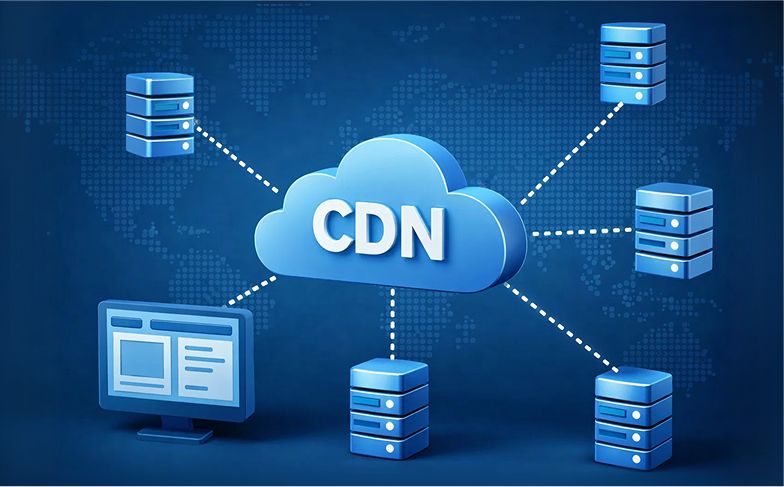
A CDN (Content Delivery Network) is a network of servers around the world that stores copies of your site's static content:
images
CSS
JavaScript
video
When a user opens your site, these assets load not from your main server, but from the nearest CDN node. As a result, pages load faster and the load on your server drops significantly.
Edge infrastructure takes this a step further.
These are smart servers at the edge of the network. They can do more than serve cached content — they can also run computations closer to the user: assembling page blocks, handling API requests and parts of dynamic content, and routing traffic. In other words, edge is a CDN with added intelligence. It lets part of the computation run closer to the user, at what are called edge nodes.
A simple comparison
Picture your Magento infrastructure as a Michelin-starred restaurant.
The Magento server is the kitchen, where every dish is prepared.
CDN and edge are the network of flawless waiters who deliver finished dishes to customers across the city.
If every customer walks straight into the kitchen, it quickly gets overwhelmed. But if the waiters take on part of the work, the kitchen can focus on what matters most — preparing new orders. This is exactly how CDN and edge infrastructure help eCommerce projects scale without a proportional rise in server costs.
Where eCommerce actually loses money on infrastructure
In most Magento projects, the server spends resources on more than just actual purchases. Infrastructure is most often loaded down by:
Anonymous traffic. Most users aren't logged in. Without effective caching, every page view can trigger a request to the backend.
Bots and crawlers. Search engine bots, price-monitoring services, and scrapers can generate thousands of requests.
Peak marketing loads. During promotions or seasonal sales, traffic can spike several times over.
API requests and integrations. ERPs, mobile apps, and headless frontends rely heavily on APIs, adding extra load.
Without the right architecture, the Magento server has to handle all of these requests itself.
So what does Cloudflare actually mean in the context of Magento
Cloudflare is a global company that provides CDN, edge infrastructure, attack protection, and performance optimization tools. It sits as an intermediate layer between the user and your server.
In an eCommerce context, it performs several important functions:
caching HTML pages at edge nodes
distributing traffic across a global Anycast network
filtering bots and protecting against DDoS attacks
optimizing protocols (HTTP/3, Brotli)
As a result, a significant share of requests get handled closer to the user, without involving Magento at all.
Varnish vs. Cloudflare: how edge cache differs from Magento's classic cache
Experienced Magento engineers might reasonably ask: if Magento already uses Full Page Cache and often runs alongside Varnish, why do we need CDN caching too?

Varnish is indeed the classic solution for caching Magento pages. It works as a reverse proxy: it accepts user requests, serves cached HTML pages, and only passes the request on to Magento when necessary.
The typical flow looks like this:
User → Varnish → Magento → database
This effectively reduces the number of requests reaching Magento, but it has an important limitation: Varnish runs within the same infrastructure as Magento.
This means that:
the cache uses the same server resources (CPU and RAM)
during peak loads, Magento and Varnish are effectively competing for resources
scaling still happens by adding server capacity
In other words, Varnish reduces the load on Magento, but doesn't remove it from the infrastructure entirely. Cloudflare works on a different model.
In this case, the cache lives not in your infrastructure, but in a global network of edge servers. The flow looks like this:
User → Cloudflare edge → cache → response, or a request to Magento
As a result:
some requests never reach your server at all
HTML pages can be served straight from edge nodes
bot traffic gets filtered out before it reaches Magento
static assets load from the nearest point on the network
Another practical difference is resilience. If the Magento backend is temporarily unavailable, the edge cache can keep serving stored pages to users.
That's why modern Magento architectures often use both approaches together:
Varnish — for fast caching within the infrastructure
Cloudflare edge — for global traffic distribution, bot filtering, and reducing server load
This layered model is what allows eCommerce projects to scale without a proportional rise in server costs.
How edge architecture cuts cloud costs
The main effect of a CDN isn't just site speed. It changes the whole load model. Instead of scaling servers, the infrastructure scales the cache.
As a result:
CPU load drops
RAM usage drops
auto-scaling kicks in less often
bandwidth costs drop
For eCommerce projects, this means a more stable infrastructure cost model.
When a CDN won't solve the problem
It's important to understand that while edge infrastructure supports the right architecture, it doesn't fix fundamental backend problems.
For example:
slow SQL queries
inefficient code
an overloaded database
misconfigured Magento indexers
This is exactly why sound infrastructure optimization always starts with a technical audit from our team. You can reach out to us and start the process with a consultation, so we can map out the next steps together.
Make performance engineering part of your business strategy
Why this is no longer just a matter of speed
In 2026, site speed isn't just a UX metric. It's part of an eCommerce business's financial model.
When every new user means new server load, infrastructure scales by consuming computing resources — one of the most expensive ways to grow.
That's why CDN and edge architecture today are viewed not just as a way to speed up a site, but as a way to control costs and scale eCommerce projects sustainably.
This is an architectural decision that involves analyzing load patterns, designing a caching strategy, optimizing Magento, and modeling peak-load scenarios.
At Planeta Web, we approach infrastructure with the same systematic approach as development: we identify where costs are getting out of hand, build edge architecture, and optimize Magento with scaling in mind. If your cloud costs are growing faster than your business, that's a signal to rethink your architecture — not just your hosting plan.