
Online payments are one of the key conversion points in eCommerce, and Rozetka Pay holds a prominent place in this process: more than 28,000 Ukrainian companies already use the service to accept payments, subscriptions, QR payments, and invoices. Businesses choose it for its simple setup, competitive fees, and a branded payment page featuring the most popular payment methods.
Rozetka has a clear strategy. As co-owner Iryna Chechotkina explains in an interview with Fedoriv Vlog, the goal is to make buying as simple as possible: "the customer just needs to come in, click a button — and the order goes wherever it needs to go." That's why the company keeps building its own ecosystem of services — everything that makes sales frictionless, including on third-party sites.
For businesses, this payment solution opens up another fundamental advantage — access to 16 million identified Rozetka users as of 2025, who can pay on your Magento site just as quickly as on the marketplace itself.
What your platform can gain after integrating Rozetka Pay:
Simpler checkout for repeat customers — payment details can be filled in automatically if the customer is logged into Rozetka Pay. This cuts down checkout time, though the base checkout still follows the standard Magento flow.
Higher payment completion rates — less manual entry means fewer errors and more successful transactions.
Support for the branded payment page — customers see the familiar Rozetka payment flow, which builds trust and reduces drop-offs.
Rozetka's financial tools — with customization, features such as installment plans, deferred payment, partial payments, and other tools not supported out of the box by the official Magento 2 module can be added. These capabilities can be built into your business processes through a custom integration.
Fewer barriers at checkout — especially important in markets where 60–70% of carts are abandoned right at the final step.
Despite the existence of an official Rozetka Pay module for Magento 2, in practice integration almost never comes down to simply installing a plugin.
Every eCommerce project has its own nuances:
business logic and order rules
ERP/CRM integrations
different order statuses
complex post-payment scenarios
security requirements
two-step payment (fund hold → capture)
split or partial payments
This is where Planeta Web's work begins: adapting Rozetka Pay to a company's actual processes, architecture, and scale, taking into account the limitations of the base module.
Why Ukrainian eCommerce businesses integrate Rozetka Pay
Rozetka Pay is part of an ecosystem that has demonstrated stability, scale, and high conversion for years on the country's largest marketplace. Integrating with it, in turn, gives you access to solutions proven in high-load projects handling millions in transactions.
Key reasons businesses choose
Rozetka Pay
Predictable and competitive fees
This matters especially for businesses with high turnover, where a 0.5% difference in the rate directly affects margin. 1% for Prom/Bigl sellers; 1.5% for eCommerce businesses with turnover up to UAH 500,000; Custom rates for large stores and retailers;
Bottom line: a clear understanding of transaction costs and the ability to plan your financial model.
A full stack of modern payment methods
Bank cards, Apple Pay, Google Pay, Recurring charges and subscriptions — critical for service-based and B2B models.
This isn't just convenient — it directly affects conversion, repeat payments, and customer lifetime value.
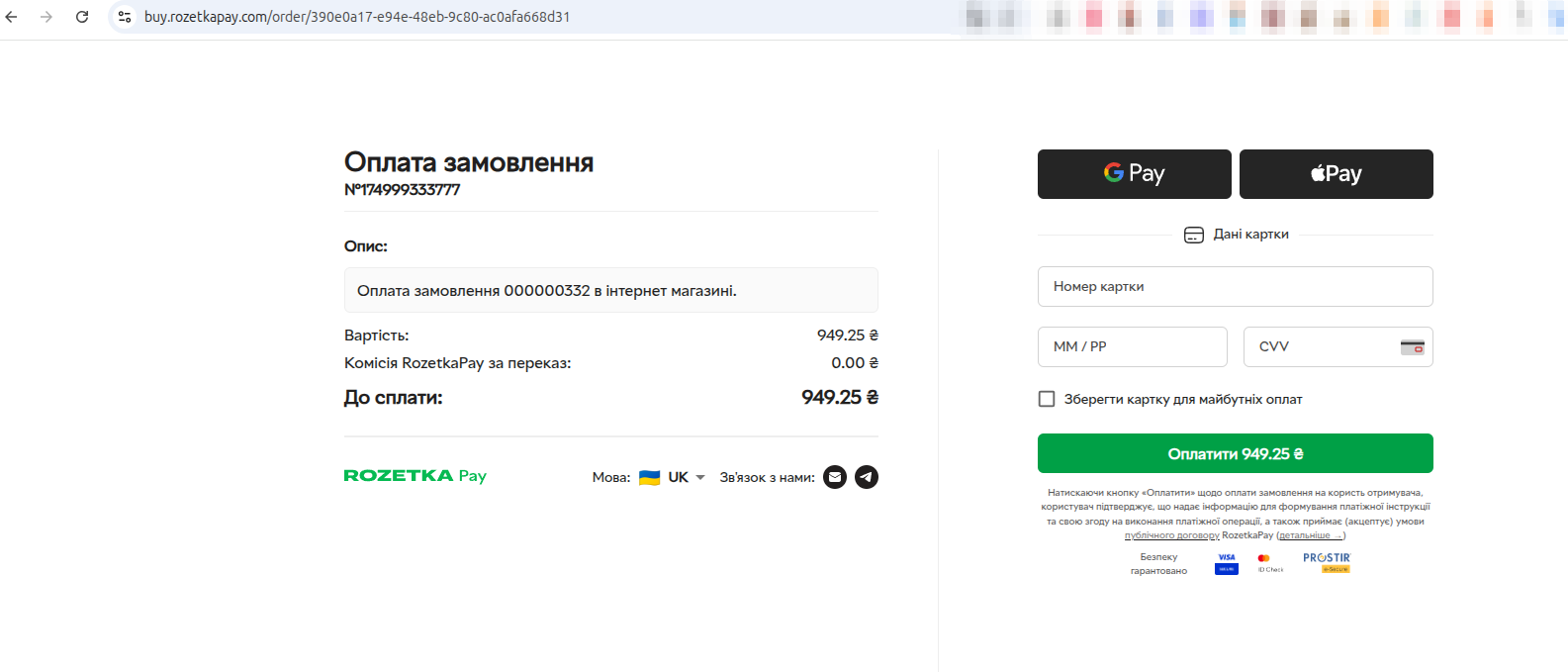
Rozetka's branded payment page
A recognizable interface means higher trust and higher conversion compared to standard bank forms. This is especially noticeable with cold traffic and first-time purchases.
ready-made integrations and SDKs
For small and mid-size businesses, this speeds up time to market. For larger ones, it means launching an MVP quickly and scaling while minimizing risk.
Magento 2 + Rozetka Pay: what happens after installing the module
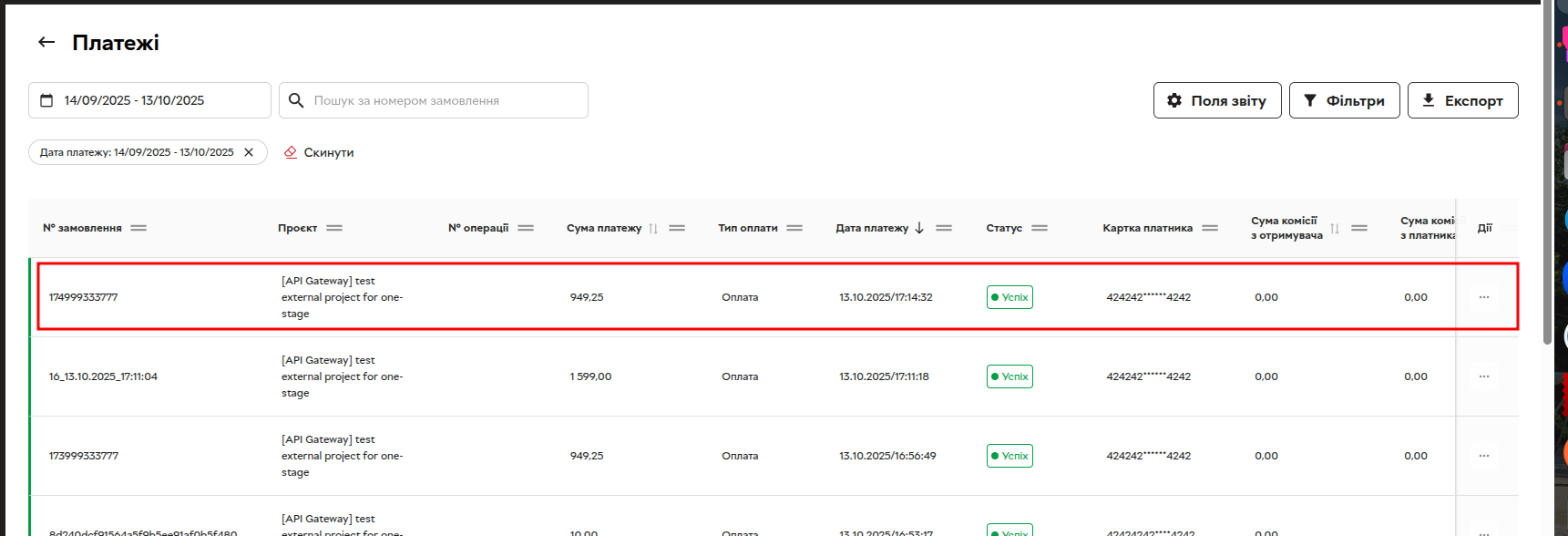
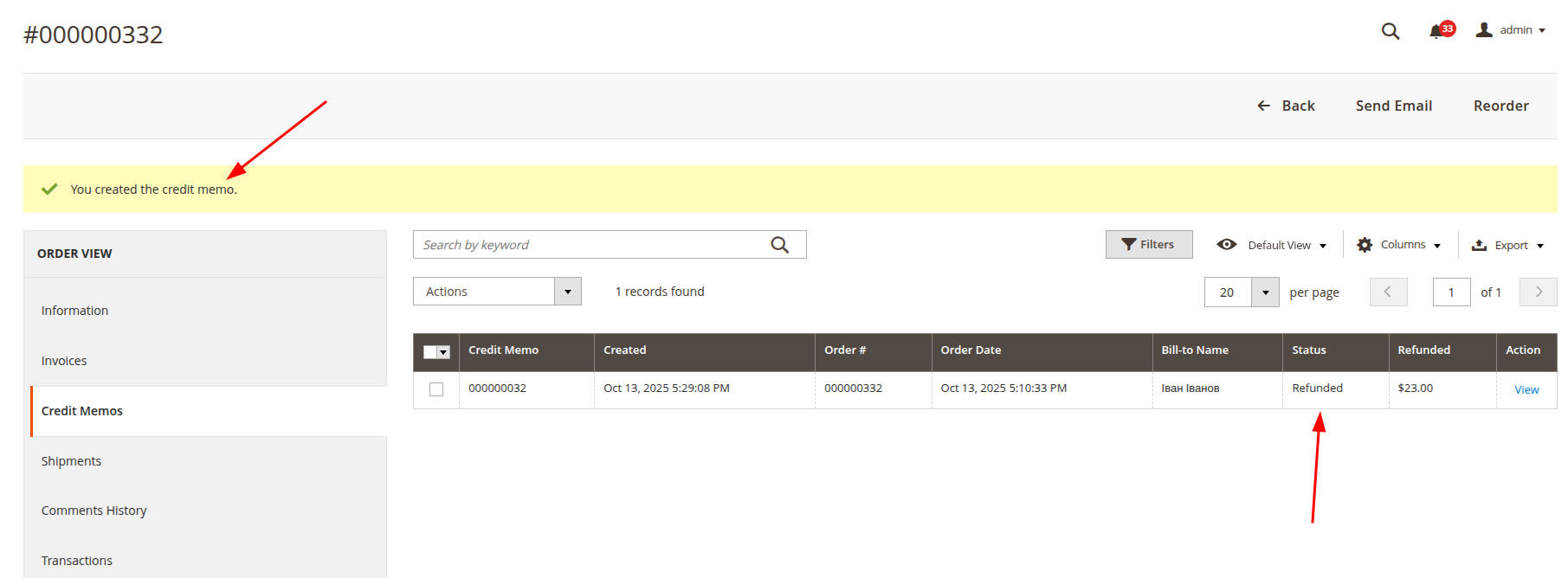
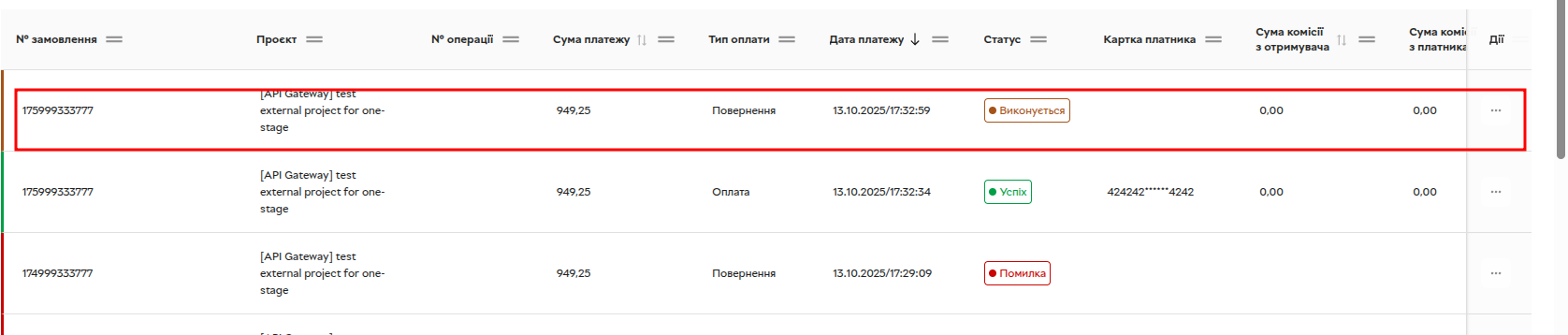
Rozetka has indeed put together a solid foundation — a module, documentation, a sandbox, and a demo cabinet. That's a good starting point, but it's not enough for real eCommerce projects. Our experience integrating with Magento 2 shows these modules rarely work as plug and play: the module needs to be adapted before it becomes part of a stable payment process.
One of our developers put it this way:
The module isn't complex, but it didn't work out of the box. We had to fix the backend, the frontend, and the refund logic. Some areas need attention, especially the refund mechanism — right now it isn't built according to Magento 2 best practices. Overall, there isn't much difference between Mono, Privat, and Rozetka acquiring: each one has to be implemented around the store's real-world workflows.
This isn't a shortcoming of the payment system — it's a feature of the Magento platform.
Magento 2 operates in complex operational environments: with custom order statuses, ERP/CRM integrations, custom checkout, partial payments, cash on delivery, prepayments, and installment plans.
In these conditions, the module is a foundation that needs further work, taking into account:
adapting the logic to your order flow;
aligning transaction and refund statuses;
checking compatibility with custom functionality;
refining the frontend of the payment step;
testing scenarios with ERP and delivery services;
checking performance under load.
Only then do you get: frictionless payments, stability, higher conversion, and access to the Rozetka ecosystem as a strategic advantage.
How the Rozetka Pay module works technically on Magento 2
Despite the official module and detailed documentation, integrating Rozetka Pay into Magento 2 requires a precise understanding of payment process architecture. Below, we explain why each stage matters for payment stability.
Installation and basic activation
Integration starts with uploading the module to app/code and running the standard set of deployment commands. It sounds routine, but this is exactly where the issues typical of base installations show up: incompatibility with certain PHP versions, outdated observers, conflicts in di.xml, or CSP restrictions when the module loads external scripts.
This stage isn't about custom checkout or unique flows — it's strictly about verifying the environment. And if all conflicts are resolved here, the rest of the integration goes much more smoothly.Module configuration
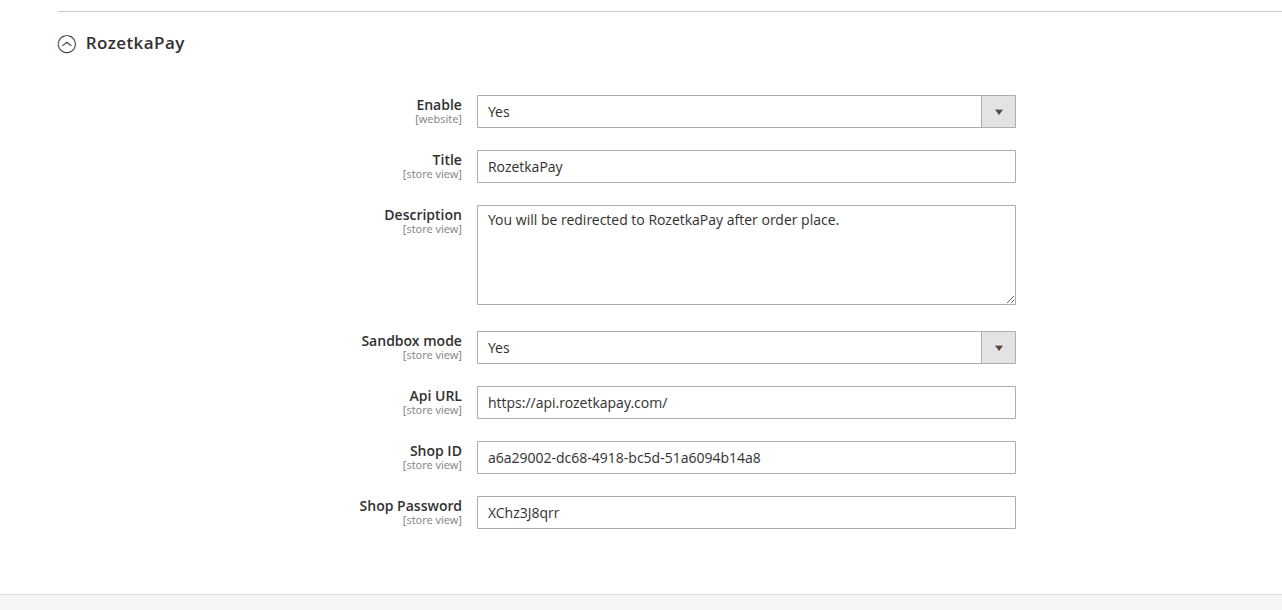
The Rozetka Pay settings panel is simple but essential for correct operation. The fields control activation of the payment method, its title and description, sandbox mode availability, the base API address, and the Shop ID and Shop Password used to authenticate requests.
This is straightforward configuration with no hidden pitfalls — you just need to fill in the fields correctly and make sure the connected keys work in the selected environment.How the payment flow behaves
Rozetka Pay's payment flow in Magento works as expected: the customer places an order, is redirected to the payment page, completes payment, and returns to the store. A webhook confirms the final status.
It's important to account for the module's specific logic here. Some integrations create the order before the redirect, so if the webhook is delayed, the system won't create an invoice or transaction until confirmation arrives. If the webhook never arrives at all, no payment data will show up in the admin panel — and that's a scenario you need to plan for.
Special attention should also go to interaction with custom checkout extensions: they can change the Place Order steps or redirect logic. This isn't a guaranteed problem, but it's a risk that only surfaces during integration.How refunds work
The standard module implementation uses offline refunds. For most businesses, that's enough: the money is returned, the customer gets what they expect, and the store doesn't run into any critical limitations.
If you need extended functionality
— partial refunds, automatic transaction reconciliation, full transparency for accounting — we extend the module to support online refunds with logging and more predictable behavior. This isn't a problem to fix so much as an opportunity to improve stability where it truly matters.
Trust your Magento and Rozetka Pay integration to specialists who work with Magento at the architectural level
At Planeta Web, we build payment architecture that runs reliably in every scenario — from standard payments to unusual cases with peak load. In more than ten years of working with Magento, we've seen that an integration only becomes truly reliable once the module is adapted to a business's actual logic, not just installed "by the book."
That's why, during implementation:
We don't just connect Rozetka Pay — we adjust the key mechanisms that affect how payments behave.
We optimize the module for the store's specific requirements, configure proper webhook handling, ensure correct invoice and status generation, and account for interaction with ERP, CRM, and delivery services.
At the same time, we model complex scenarios — prepayments, partial refunds, cancellations, repeat payments — to see how the system behaves outside the ideal flow.
For high-load projects:
We add an integration layer with queues or cron processes. This ensures transactions, orders, and statuses aren't lost even during peak hours or major sales. This approach doesn't just make the payment method work — it delivers the predictability that's critical for large-scale eCommerce.
Rozetka Pay integration: the architecture we build
For the payment flow to work in every scenario, the integration includes several technical layers.
1. Analysis. Payments are a byproduct of your processes. At the start, we determine:
the payment types the store needs;
whether there are recurring charges;
how the ERP/CRM works and where the "source of truth" for orders is stored;
whether there are complex checkout extensions;
how logistics and cash on delivery work.
This step helps avoid stuck transactions, conflicts with delivery services, and duplicate statuses.
2. Choosing the integration type: three models. We offer three options, depending on how complex your system is:
Direct integration. Suited for a fast launch in smaller stores. Basic setup with minimal customization.
Reverse integration. Syncs statuses to your CRM, ERP, and warehouse systems. Important for stores with high order volumes.
Comprehensive integration. Integrates the full logic: checkout → payments → orders → warehouse → CRM → emails → analytics. Suited for mid-size and large eCommerce businesses.
3. Defining the technical specification. The spec documents exactly what we customize:
success/fail/unknown behavior scenarios;
webhook handling;
invoice logic;
edge cases;
delivery and final status integration.
This lets us forecast budget and timelines and rule out production errors.
4. Implementation: building a working payment architecture. At this stage, we:
install the Rozetka Pay module
resolve conflicts with other modules
rewrite parts of the logic (if needed)
configure webhook handling
stabilize the invoicing mechanism
model the behavior of three flow types: success, failure, and unknown
For complex projects, we add an integration layer or RabbitMQ queues.
5. Testing: not just verification, but modeling real-world situations. We test:
successful transactions
payments through different methods (card, GPay, Apple Pay)
failed transactions
duplicate webhooks, delayed webhooks
status updates in Magento
behavior in CRM/ERP
repeat payments
6. Post-integration support: payments are a living system. Even after launch, the Planeta Web team:
monitors the module's behavior
adapts the logic to new business processes
checks stability after Magento updates
advises the client's team
adds new scenarios (partial refunds, split payments, etc.)
Bottom line: Rozetka Pay integration is engineering work
At Planeta Web, we've worked with Magento for more than 10 years, and we know what a reliable, tested, and scalable payment architecture should look like.
We don't just connect the module — we build a system that:
runs reliably under load, handles all payment scenarios correctly,
delivers the checkout conversion you expect,
syncs data with ERP/CRM,
ensures predictable transactions.
If you need a Rozetka Pay integration adapted to your business and your order logic, we're ready to help.
The official module provides a solid foundation, but:
stability, correct status handling, and compatibility with custom modules and ERP are matters of team experience, not just a plugin.
That experience determines how seamless the customer journey will be, and whether the business gets the results it's counting on: higher conversion, fewer drop-offs, more repeat payments.