
Magento 2's popularity has a downside: the platform is a regular target for attackers. New vulnerabilities surface every year, and Adobe releases patches to fix them quickly. Problems start when a store puts off installing a new patch. That window is exactly what attackers use to target stores running outdated versions.
Magento 2 hacks: how attackers operate
In most cases, attacks do not start with sophisticated hacking or hunting for unknown bugs. Attackers automatically scan stores for known vulnerabilities that the vendor already patched long ago.
The most common attack scenarios:
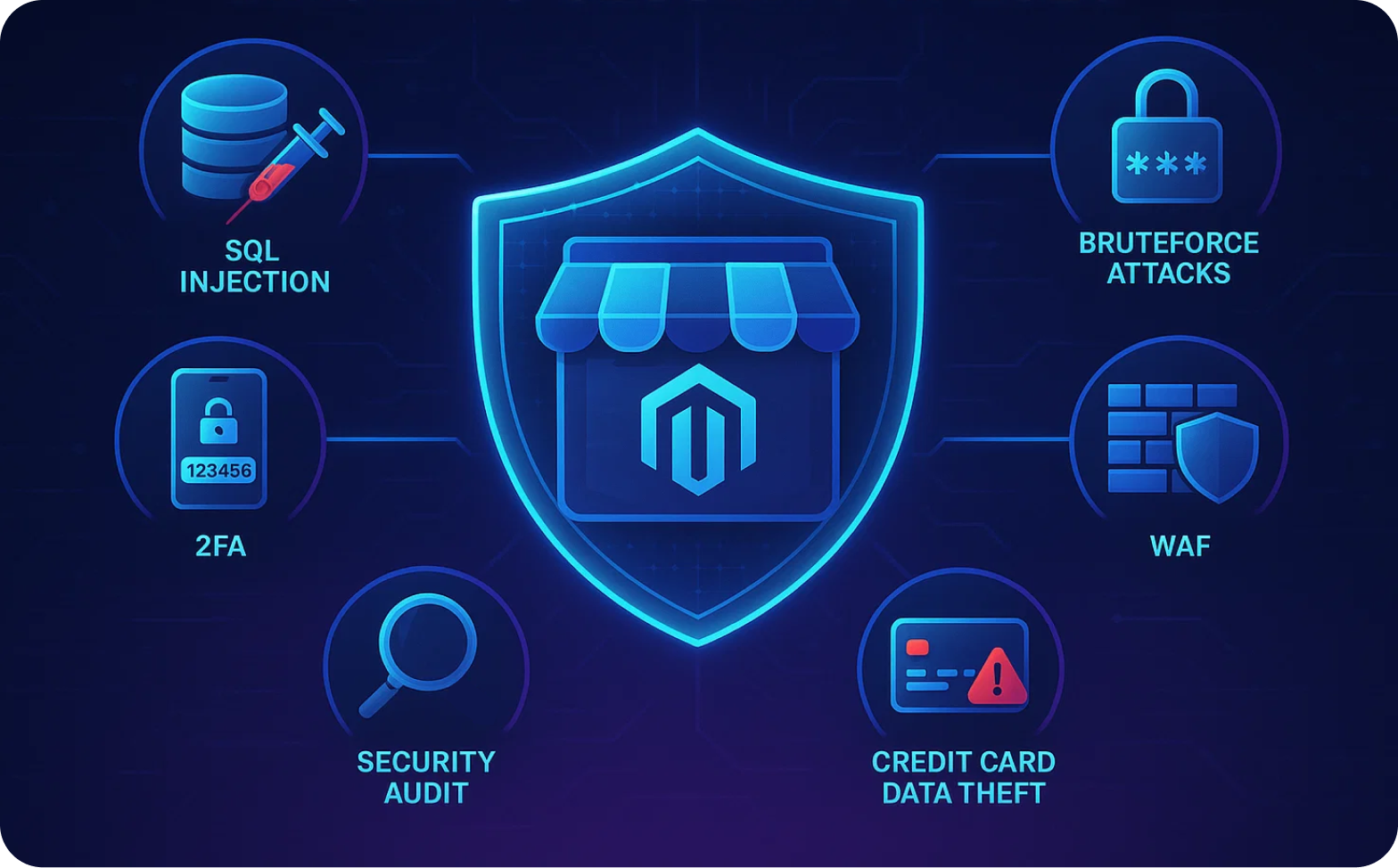
SQL injection — exploits query-handling errors to gain access to the database.
XSS (cross-site scripting) — runs malicious JavaScript in the user's browser to alter page content or steal data.
RCE (remote code execution) — lets an attacker run commands on the server and take control of the store.
Magecart — injects malicious JavaScript into the checkout page to steal customers' payment data.
What happens after a successful attack
After a successful attack, the damage rarely stops at the website itself. Attackers can steal customers' payment or personal data, gain access to the store's admin panel, plant malicious code, or set up redirects to third-party resources.
If the site ends up on Google Safe Browsing's blocklist, some users won't be able to open it without a browser warning. That comes with a drop in traffic and the cost of restoring the store's operation. And the biggest problem for any business is losing customer trust. To avoid this, update your site on time. If you haven't done that in a while, we can help. We offer full support and development services for Magento 2 online stores, so you don't have to worry about this on your own.
Critical Magento vulnerabilities: real-world examples
The most high-profile example in recent years is CosmicSting (CVE-2024-34102). In June 2024, Adobe released a security update for Magento Open Source and Adobe Commerce that closed this critical vulnerability. It received a near-maximum CVSS score of 9.8 out of 10, putting it at a critical risk level.
But as usual, not everyone installed the update right away. According to SANSEC, about 75% of stores kept running the old, vulnerable version of Magento for a while. These sites became the main targets of mass attacks. More than 4,000 stores were compromised.
This is far from an isolated case, even in just the past few years. That same year, Adobe fixed a critical vulnerability, CVE-2024-34111, that could lead to remote code execution. And in 2022, the company had to release an out-of-cycle update for CVE-2022-24086 because attackers were already actively exploiting it.
Staying on top of new threats doesn't require being online around the clock. Checking a few reliable sources regularly is enough:
Adobe Security Bulletin — official announcements of new vulnerabilities and released patches;
SANSEC — research on current attacks and threats targeting Magento;
CVE databases (including the NVD) — information on registered vulnerabilities and their severity level.
Why you shouldn't put off Magento 2 updates
When Adobe releases a security patch, it closes a vulnerability that has already been found. At the same time, information about it becomes public, so attackers start looking for stores that haven't updated yet.
That's why sites running outdated versions of Magento face the highest risk. Updating Magento 2 on time doesn't guarantee absolute protection, but it closes known attack vectors before they can compromise the store. This isn't a technical formality — it's a basic security standard.
How to keep Magento secure
Updates are just one part of security. Before installing them, check compatibility with your theme, third-party modules, and integrations. That's why changes are usually tested in a staging environment first and only then deployed to the live site.
A few basic practices are enough to reduce the risk:
monitor the Adobe Security Bulletin and new CVE entries;
install Magento 2 updates as soon as they're released;
keep third-party modules up to date;
test updates before deployment;
restrict access to the admin panel.
Experience from recent years shows that critical vulnerabilities will keep appearing. What matters for a store owner isn't whether a new CVE will emerge, but how quickly the update gets installed. And if you don't know what Magento version you're running or whether it needs updating, you can always reach out to us, and we'll take care of it.