
With Luma, you're always optimizing complexity that already exists. With Hyvä, you simply never create it.
said our Senior Magento Developer
We remember when Magento didn't really offer a choice of frontend. There was a de facto standard — Luma: complex, heavy, but understandable and predictable. It never aimed for elegance or technical sophistication. Instead, it gave the whole ecosystem a solid base to build on.
Businesses adapted to these rules:
timelines factored in slow releases,
budgets factored in constant optimization,
and processes factored in compromise.
That held true until the market itself changed.
Today's users don't compare your site to other Magento stores. They compare it to every digital experience they're used to — from marketplaces selling home goods to fitness apps counting their steps. In that comparison, even a few seconds of delay costs you the user's attention. And that translates directly into lost conversions.
At some point it became clear: the limitation wasn't Magento as a platform — it was how the frontend was built.
That's where Hyvä comes in. First as an alternative, then as an experiment, and eventually as the new standard.
To understand why this happened and what to choose now, you need to look at several things together:
how speed and UX requirements have changed,
why Luma stopped meeting them at the architectural level,
what exactly Hyvä changes, what alternatives exist, and how this plays out economically in real projects, from development through scaling.
This topic has long since moved past technology for technology's sake. It's about the speed of change, control over the product, and the cost of development over the long run.
If you're weighing your options right now and want to understand how the frontend works in your industry, let's talk specifics.
Architecture that stopped keeping up with the market
For a long time, teams tried to bring Luma up to modern standards. They optimized JavaScript for it, added caching, rebuilt critical flows. It worked, up to a point, and created a sense of progress.
But that illusion had a limit.
The bigger the project grew, the clearer the pattern became: speed in that architecture isn't a property of the system. It's the result of constant effort — something you have to maintain, fight for, and keep under control.
Every new feature adds weight.
Every integration adds dependencies.
Every design change creates risk of a side effect.
Every change pulls the team back to the balancing point between features and performance.
At some point, development stops being about building things. It becomes about maintaining balance.
And that's where technology starts to dictate the economics of the business.
It's not just development time that grows — the cost of every change grows with it. The pace of product development stops depending on good ideas and analysis, and starts depending on how hard those ideas are to implement.

This is an effect the business feels not through code, but through numbers: development time climbs, costs pile up, and site speed stays an unstable variable.
And the most important part: there's no final fix for this. There are only more or less complicated ways to keep it under control.
That's exactly the point where Hyvä enters the picture.
Hyvä as a change in logic, not just a tool
Hyvä is usually described as a fast frontend for Magento. That's partly true — sites built on it really do run faster. At its core is a different approach to the frontend, built on a stack that minimizes unnecessary complexity:
Tailwind CSS lets you assemble an interface from small, ready-made classes instead of large, heavy stylesheets. Less code means less chaos, which means faster development and easier maintenance.
Alpine.js is a lightweight JavaScript library for basic interactions (menus, filters, clicks) without loading the page down with a heavy framework.
Minimal JavaScript means the page isn't weighed down with unnecessary logic, so it loads faster and runs more reliably.
But that description simplifies things to the point where the real point almost disappears. Hyvä isn't about speed as an isolated feature. It's not even about a specific set of technologies.
It's about a different way of handling complexity.
In the classic approach, the Magento frontend is a system whose complexity you have to constantly manage: optimize, balance, and rein in.
Hyvä changes that logic: instead of managing complexity, it reduces it at the architectural level.
Fewer dependencies doesn't just mean less code. It means predictability.
The effect of invisible connections — where a change in one place unexpectedly breaks something else — disappears. Development shifts from cautious intervention to controlled growth. That's the key shift.
The frontend stops being a layer you constantly have to maintain and hold in check. It becomes a tool you can actually build on.
For a business, that translates into something simple but critical: the site stops behaving like a system that creates constraints and starts behaving like a platform that supports growth.
Why the market is choosing control over speed
At first glance, switching to Hyvä might look like it's about performance. But look closer at business decisions, and it becomes clear: this isn't really about speed as such.
It's about the economics of change.
Headless and PWA solutions can deliver high performance, but they bring their own complexity — architectural, organizational, financial. They require dedicated teams, complex maintenance processes, and longer development cycles.
Luma, by contrast, is simple to start with but expensive to scale.
Hyvä sits between these two extremes not as a compromise, but as a different model altogether. It strips out excess complexity wherever it doesn't add business value, while leaving enough flexibility for growth.
What sealed it was also the fact that most eCommerce projects don't actually need a maximally complex architecture.
What this shift looks like in practice
We used to spend more time estimating changes than actually building them. With Hyvä, most work falls back into a normal rhythm — discuss it, build it, check it.
Project manager
In many teams, the move to a new architecture doesn't look like a strategic decision. It looks like an accumulation of small problems.
First it's delays in development. Then it's how hard changes are to make. Then releases get more expensive. And at some point it becomes obvious that the system isn't just supporting the business anymore. It's starting to hold it back.
After switching to Hyvä, it's not just site speed that changes — decision-making speed changes too, because the architectural resistance disappears.
Where Hyvä has performed best
Looking past the technology at real-world implementations, Hyvä performs best where the frontend directly affects revenue.

Niche eCommerce startups
When you need to launch fast and look competitive next to major players right away, without a long development cycle.
For example, one eCommerce startup in the collectibles space launched from scratch — without a large budget, but with high demands on trust and product presentation. In categories like this, users make emotional decisions but verify them rationally: photos, details, authenticity, site speed. At the start, the classic stack choice was on the table: launch on SaaS, or go with control and scalability through Magento. They chose the latter, with Hyvä as the frontend.
The result:
launch took about a month,
the site ran fast and stable from day one,
no post-launch performance work was needed.
Large, high-traffic stores
Where even a small delay in site performance turns into lost conversions. On one such project for a fashion retailer, pages loaded in about 1.8 seconds on average.
After switching to Hyvä, that figure dropped to roughly 0.8 seconds.
Core Web Vitals improved by more than 30% as well.
The difference may look small, but in real numbers it means fewer bounces, more page views, and a meaningful lift in conversions.
B2B platforms and complex catalogs
When a site is part of a larger system (warehouses, ERP, integrations), or has large catalogs, dozens of filters, and custom pricing, all of that puts load not just on the backend but on the frontend too.
For example, on a project for an equipment manufacturer:
we redesigned the UX around real purchasing workflows,
added quick order,
added saved cart,
and simplified navigation through a large catalog.
Hyvä delivered a predictable frontend here with no domino effect, along with fast logic changes and less technical debt. It made the system easier to develop further, which helped drive repeat orders.
Scaling businesses
When the main problem isn't the site itself, but the cost and speed of making changes — and when there's a risk of breaking the system by adding new features, integrations, and changes. Hyvä reduces architectural resistance and lets teams roll out ideas faster.
Retail and lifestyle brands (mobile-first projects)
A separate category: brands focused on UX and mobile traffic — cosmetics stores, sports nutrition, home goods, and similar categories, where most users are on smartphones and speed directly affects behavior and revenue. Here, the difference between a heavy and a lightweight frontend shows up immediately.
Hyvä delivers a lightweight interface, fast mobile UX, and stable performance even with a large catalog.
In these examples, compared to Luma, Hyvä delivered not just stability and speed but also more room to maneuver for future growth.
Of course, there are other cases too.
If your project is small, with no plans to scale, no complex integrations, and no high performance requirements, sometimes it doesn't make sense to complicate the architecture.
Or, if a business is building a complex headless ecosystem or a product with nonstandard frontend logic, other approaches may be needed.
How we approach projects at Planeta Web
On every project, we look at several things: how the business makes money, where it's losing money and customer attention, where it plans to grow, and what's holding it back right now.
Only after that do we decide:
whether Hyvä would deliver a real advantage,
whether it's better to keep the current architecture and optimize it,
or whether it makes sense to build something more complex, like a headless system.
This approach helps avoid the most common mistake: choosing a technology just because it's new and being talked about.
Why Hyvä is no longer a trend but a structural shift
Over the past few years, Hyvä has grown beyond being just a technical solution. It has become an ecosystem with its own standards, certifications, community, and products that are shaping a new norm around it.
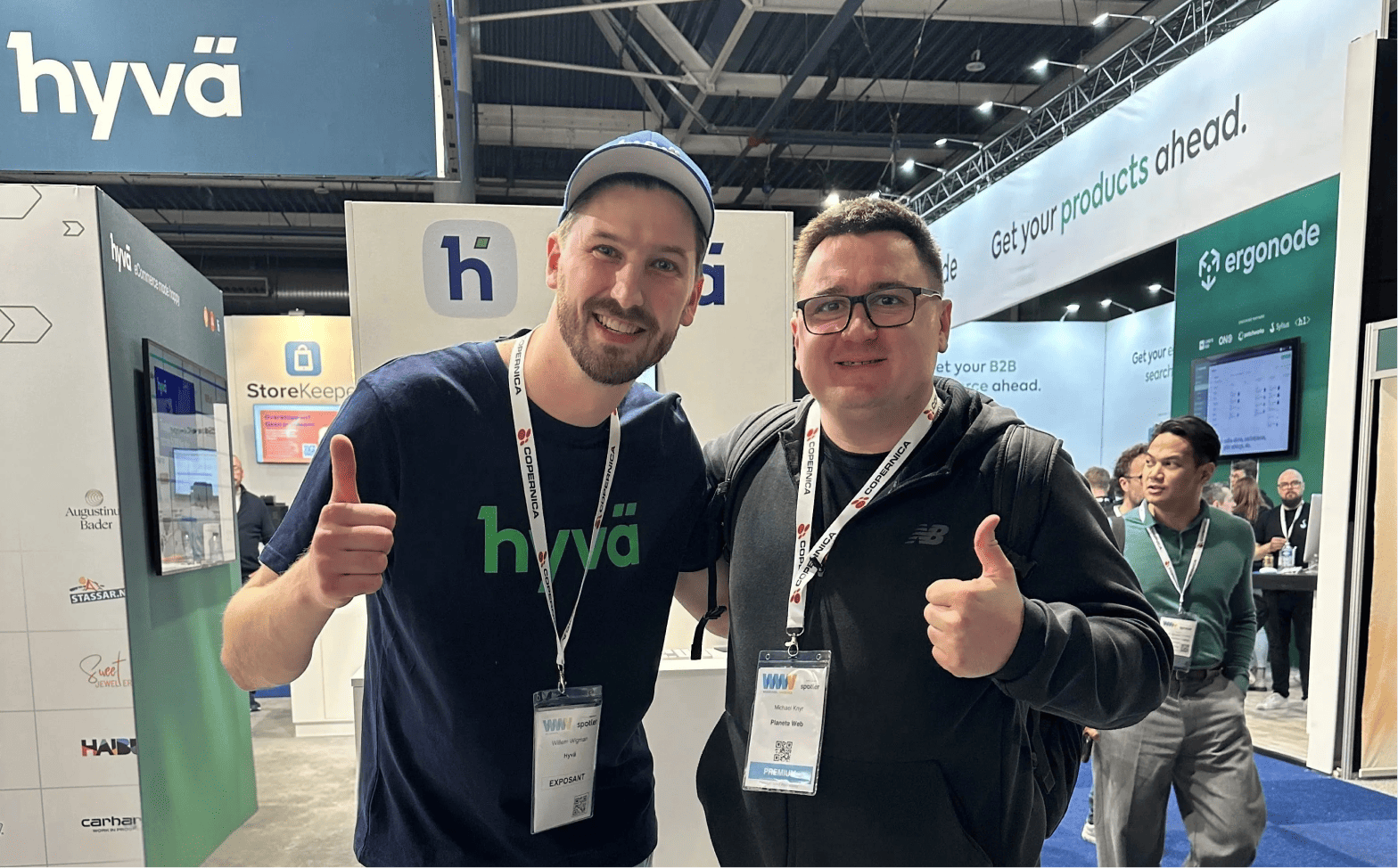
The Planeta Web team contributes to its development: we regularly take part in improvements, and our developers are recognized among those actually shaping the product. We know Hyvä's founders directly and stay in touch with them, so we understand not just how to use this stack, but how it's evolving from the inside and where it's headed next.
That matters more than the technology itself, because in digital ecosystems a standard isn't set by declarations — it's set by adoption and widespread use. That's why the market's language is already shifting: more and more, the question isn't "Magento or not" but "Hyvä or not."
This doesn't mean Magento is disappearing. It means the way it's used is changing.
For us, Hyvä is more than just a technology we work with.
Hyvä vs Luma: the technical case for choosing
Strip the discussion down to the engineering level, and Luma and Hyvä solve the same problem — building a Magento frontend — through fundamentally different approaches.
Luma is the classic Magento architecture, built on a large number of JavaScript libraries and a complex dependency system. It's universal and deeply built into the ecosystem, but that universality comes at a cost: every additional component adds load to the frontend, and every customization adds to technical debt.
Hyvä rejects that approach. Instead of optimizing complexity, it reduces it. The architecture is based on a minimal toolset and a direct-rendering approach to the interface, without unnecessary layers of abstraction.
As a result, the difference shows up not just in speed but in the entire working model:
Luma builds a system that gets more complex with every new feature.
Hyvä builds a system that stays stable even as it scales.
Luma depends more on constant optimization. Hyvä depends on a simple architecture from the start.
Luma often requires separate effort to hit modern performance benchmarks.
Hyvä hits those benchmarks with its base implementation.
It's important to understand: this isn't about which tool is better or worse. It's about which complexity model a business is willing to maintain over the long run.
So what are the alternatives?
There are also alternative approaches to the Magento frontend beyond this comparison — from PWA solutions to fully headless architectures. They address performance and flexibility, but at a different level of technical complexity and maintenance cost.
The conclusion the market has already reached
Magento hasn't gotten slower. What changed are the requirements around speed, UX, and the cost of development. If Luma was a reasonable answer to yesterday's challenges, today it increasingly becomes a constraint.
On the other hand, Hyvä isn't a universal solution, and it's unlikely to become one. But it has already earned a solid position in the choice between complex and simple architecture — in the places where every delay in development translates into lost revenue.
And on that choice, most businesses have already settled on the new standard.
Because in modern eCommerce, speed isn't a technical parameter — it's a condition for growth. The frontend has stopped being just an interface layer. It has become a factor in the business's bottom line.